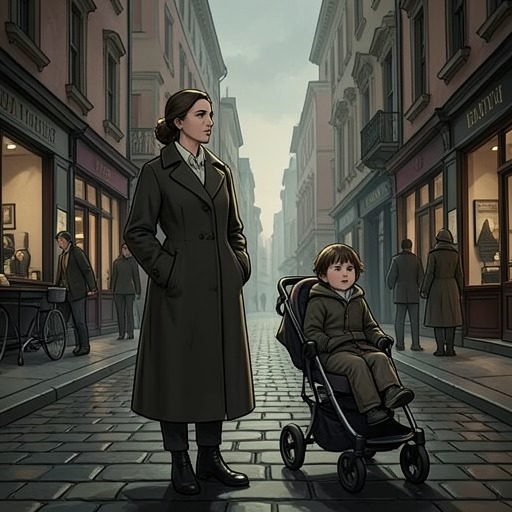
Founding the anonymous blog “Hasidic Feminist”
Unorthodox: The Scandalous Rejection of My Hasidic RootsDevorah’s founding of the anonymous blog “Hasidic Feminist” turns private writing into a guarded public forum: a place to examine her life, speak about a subject she had never disclosed, and encounter readers living beyond the limits of her immediate community. The blog does not itself resolve her circumstances, but it gives her a new way to articulate them—and exposes the stakes of imagining a future for herself and Yitzy.
Secrecy and the need to write
By this point, Devorah’s outward observance and inward convictions have diverged. She keeps kosher, dresses modestly, and presents herself as a devout Hasidic woman, while privately yearning to escape the restrictions that keep her from seeing and experiencing more. She regards her true self as the most important secret she must hide from Eli.
Before marriage, she had written her thoughts in journals. After marrying Eli, she stopped: she feared that he might find and read them, and that the pages would let him see what she kept hidden. The change is practical as well as inward. Her thoughts continue to accumulate, but a notebook left in the home could become incriminating evidence of the changes taking place in her. An online journal offers another possibility: expression without an identifiable name attached to it.
The blog draws on material from Devorah’s studies at Sarah Lawrence College. Its entries are shaped by feminist readings in philosophy and by writing from her theater and writing classes. The project therefore brings together ideas she is encountering beyond her community and the experience she has been unable to discuss openly. Anonymity is essential to that combination: it gives her room to write while protecting her identity from readers who could hold her accountable in her daily life.
A first post about marriage
Devorah chooses her prolonged inability to consummate her marriage as the blog’s first subject. She had never admitted the problem to anyone and would not ordinarily have considered publicizing it. Her decision follows a phone call from an unidentified woman in Williamsburg, who had received Devorah’s number from Aunt Chaya. The caller explained that her recently married daughter had been unable to consummate her marriage for eight months and asked whether Devorah had advice.
The request unsettles Devorah’s belief that she is an exceptional case: she had understood her difficulties as an anomaly in her community and in the wider world. Now another mother is searching for an explanation and help for her daughter, without an apparent concrete reason for the problem. Devorah offers what advice she can, although she has not yet fully understood her own experience. The call does not supply her with an answer; it makes silence harder to maintain. Someone else’s need for guidance gives her a reason to put her own story into words.
Writing about what she thinks of as her serious defect feels unexpectedly freeing. The post makes a previously concealed experience available to strangers, but anonymity preserves distance between the disclosure and Devorah’s publicly recognizable identity. That tension—saying something plainly while remaining unseen—defines the blog’s initial function.
Readers gather around the screen
Comments arrive in a volume Devorah does not expect from what she had thought of as a tiny corner of cyberspace. The readers include rebellious Hasidim, former Hasidim, modern Orthodox Jews, and gentiles. Their responses differ: some doubt that a girl could pass through adolescence without noticing her vagina, some express empathy, and others describe similar experiences. The comments become an argument among readers as well as responses to Devorah, making the blog a forum rather than a one-way confession.
Following those exchanges thrills her. She feels herself at the center of something significant while remaining safe behind the computer screen, unseen and beyond direct accountability. The response changes the scale of her private knowledge: an experience she had treated as uniquely hers becomes something other people can recognize, contest, or discuss. The screen both connects her to readers and maintains the protective separation on which the blog depends.
The question of Yitzy
The discussion soon turns from Devorah’s marriage to whether she could leave her community with her son. Readers warn that a community would not allow a nonreligious woman to leave with her child. One commenter identifies himself as a lawyer and says that, to his knowledge, it has never been done. Other readers invoke rabbinical courts and examples of women who tried to leave, arguing that even keeping the laws would not make Devorah sufficiently devout to be considered a fit parent.
Devorah is not reassured by these warnings, but neither does she have a concrete plan or know when she can leave. She believes that her situation differs from those of the women cited in the comments and holds to the conviction that she and Yitzy will eventually be free. In her imagined future, he can attend a real school and read books without fear of discovery. The comments make the practical and parental stakes of departure explicit; her response reveals that the possibility of raising Yitzy outside the community has already become part of her private horizon.
Place in the larger account
The blog marks a change in how Devorah handles the conflict between her outward life and her emerging identity. Earlier, the risk of discovery stopped her from writing privately. Now she writes again by changing the conditions of visibility: the thoughts can be read, but the author cannot readily be identified. The result is neither full public exposure nor the isolation of a hidden notebook, but a limited space in which she can test what it means to tell her story.
The memoir also places this act of writing within a longer process of questioning authority and reaching her own conclusions. Devorah later interprets her life as a journey she managed to complete without severing herself from the experiences that formed her. In that retrospective arc, the blog is a step toward expression and imagined freedom, not proof that departure is already secured. Its readers make clear how formidable the obstacles may be, while Devorah’s insistence that she and Yitzy will leave shows that their warnings do not determine the future she can envision.